Where Cacaogoto Began
Eight Days at the Dominican Republic Cacao Masterclass

San Francisco de Macorrís, Dominican Republic 2023
This was five months before Cacaogoto came into being.
I had left my previous work and was in the middle of reconsidering where I was going — when the opportunity came to join a cacao masterclass in the Dominican Republic. More than searching for something, it may have been a journey to confirm what was already inside me.
Cacao Professionals From Around the World, in the Same Room
The program was organized by Cacao Latitudes — an international education program bringing together cacao producers, researchers, chocolatiers, and chocolate makers from across the world. I had the opportunity to join its inaugural edition.
Eight days of combining university lectures with hands-on time at cacao farms, covering the cacao industry as a whole: the history and botany of cacao, farm management, fermentation and drying, certification systems, logistics and markets, and quality evaluation. Participants ranged from cacao farm owners and maker founders to chocolatiers and university professors. Nationalities spanned the United States, Tanzania, Ghana, the Dominican Republic, the United Kingdom, Australia, France, and Trinidad and Tobago — people from producing countries and consuming countries alike, in the same space. I was the only Japanese participant.
Surrounded by People Who Talked About Cacao from Morning Until Night

What stayed with me most from this masterclass was the intensity everyone brought to cacao.
We were all staying in the same place, which meant cacao came back into the conversation at breakfast, during transit, after dinner. When discussion grew heated and opinions diverged, no one stepped back. People were genuinely putting their experience and convictions against each other.
It was the first time in my life I had been inside an environment like that.
Practical Sessions at Zorzal Cacao

The hands-on sessions were held at Zorzal Cacao — a specialty cacao company founded in 2012 by Dr. Charles Kerchner, known for its approach to integrating nature conservation with cacao production.

The name "Zorzal" comes from Bicknell's Thrush, an endangered bird species, and the farm also carries out forest preservation work to protect its habitat.

At the fermentation facility, we watched and learned as beans moved from box to box through small openings — a system designed to distribute air evenly throughout the fermentation process, built through years of trial and refinement.

After fermentation, the beans are spread carefully without overlap, allowed to dry uniformly in the sun.
Cacao Cultivation and the Natural Environment

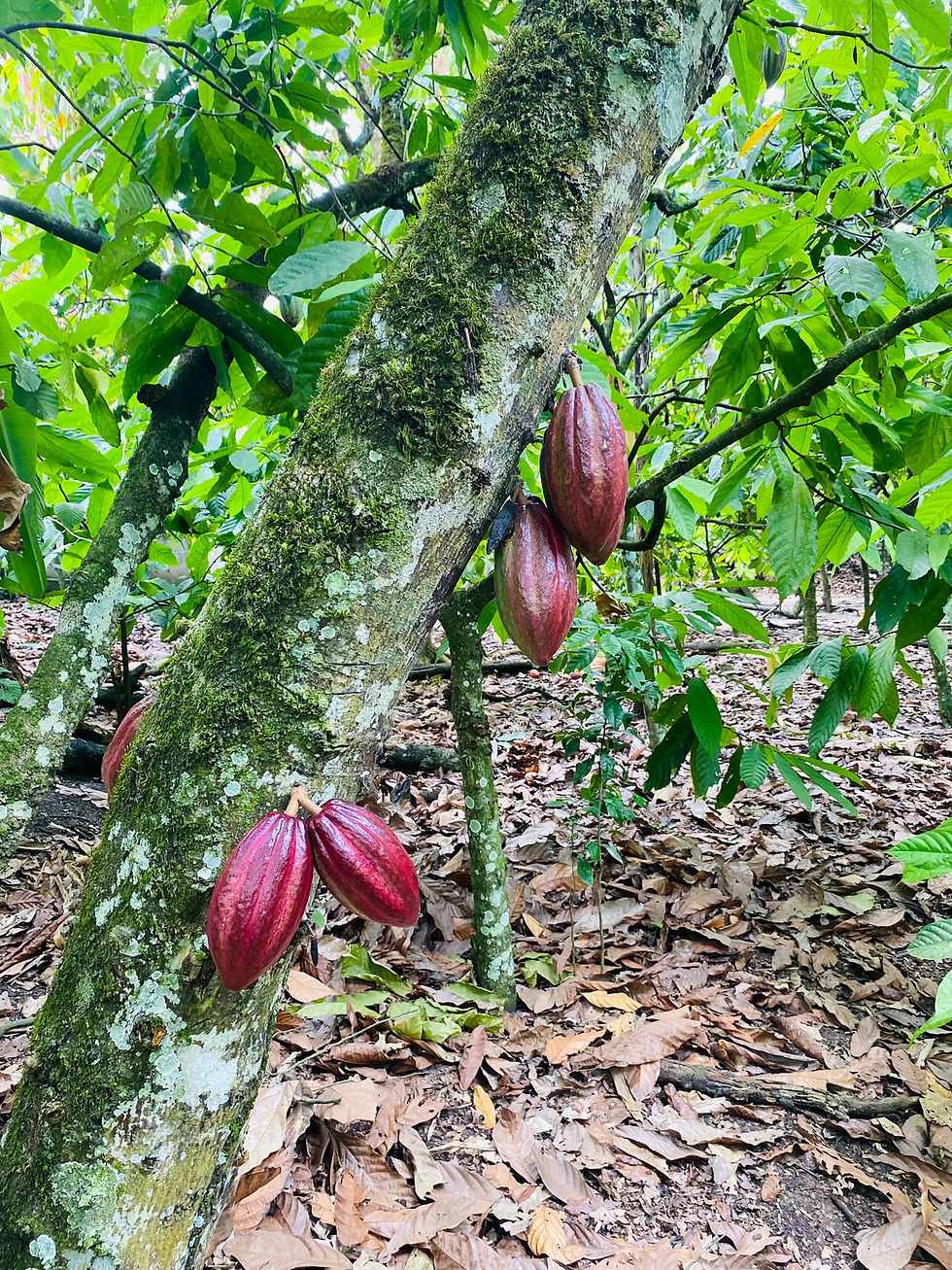
Cacao is sensitive to direct sunlight and is grown beneath shade trees.

At Zorzal, cacao is cultivated within living forest rather than cleared land. We also watched a method of grafting new cacao growth onto broken trees — working with the forest rather than against it.
A Night in the Forest

The protected area of Zorzal lies a short distance from the fermentation facility. There is a cabin there, and we stayed one night.

That evening, we gathered around a campfire and walked through the forest, talking. Not a lecture, not a debate — just people who love cacao, in the forest, at night. It felt like being a student again.
Fermentation Changes Everything

One tasting session has stayed with me clearly.
We compared cacao mass made from beans fermented for different lengths of time — tasted as they were, dissolved without sugar.
The chocolate I encounter every day is finished. I understood, in theory, how much fermentation shapes the flavor. But tasting that difference directly, for the first time, the degree of change in both taste and color was striking. Cacao runs deep. It was the moment I understood that depth through my senses.
Words From the Origin That Cut Through

There was a moment in one of the discussions I have not forgotten.
A participant who supports farms in the Dominican Republic spoke through tears. The reality of those farms, she said, is not reaching the world accurately. What producers do, the effort and care they pour into every bean — that reality is not arriving at the consumer. Words from someone who had lived it landed differently on me, coming as I did from Japan, a country far removed from cacao's origins.
From another participant, working with a cacao cooperative in Ghana, came a heavier account. Media organizations visit Ghana and capture a single moment, then broadcast it. If children appear in the footage, it becomes a story about child labor. There are places where that reality exists. But places that bear no resemblance to that picture are portrayed the same way — and some people use those narratives to raise funds that never reach the farmers. A cycle that deepens the problem rather than breaking it.
Japan is a country that uses a significant amount of Ghanaian cacao. And yet the true picture is difficult to access, and easy to distort. There are things that can only be understood by going to the origin and hearing directly from the people who are there.
To communicate accurately. That is the responsibility of anyone who works with cacao — that was what I felt in that moment.
No Fixed Definition for a Cacao Ceremony
During those eight days, a conversation with one of the participants opened something unexpected. Cacao ceremonies from the Mayan period, they told me, are being quietly revived in the present day.
I had not known that modern cacao ceremonies existed. I knew of the Mayan tradition — but I had not imagined it was being carried forward. I asked: is there a definition for a cacao ceremony?
The answer, apparently, is that there is no strict definition.
In the moment, I simply thought: is that so. But those words would begin to move in an unexpected direction after I returned home.
The Beginning of Cacaogoto
Back in Japan, I looked back at my life with fresh eyes. I had left my previous work, and had been continuing to ask myself what came next.
What I can do. What only I can do. Working through that question, one answer began to take shape. Cacao, which I had been involved with for years. And the way of tea — sadō — that my grandmother had taught me since I was in primary school. Two things that had always lived inside me, connecting for the first time.
The words I had heard — that there is no fixed rule for a cacao ceremony — had been quietly at my back.
Cacaogoto came into the world five months after this masterclass.

