A Journey to Meet the Cacao of the Solomon Islands

Guadalcanal, Solomon Islands 2024
Cacaogoto imports cacao beans from the Solomon Islands. Through that relationship, we were given the opportunity to visit as part of a program supported by the Australian government.
More than twenty hours each way from Japan. In this country of abundant nature and living cultural diversity, a journey began — one of meeting the people and the stories behind cacao.
A Farmer Filled with Passion for Cacao

The first place we visited was Amazing Grace Cocoa Farm.

What struck me first, stepping onto the farm, was the cleanliness. The paths were swept clear of fallen leaves, maintained with quiet care. The environment was more orderly than I had imagined — and before I had even met the owner, Grace Fekau, the farm itself had already introduced her.
Grace is small in stature, but her words carry weight. After losing her husband, she began growing cacao alone on a small plot, and over more than twenty years, built it into what it is today. The farm now operates as "Amazing Grace Boutique Cocoa & Garden Tour" — an agritourism experience offering hands-on cacao cultivation, traditional Solomon Islands cuisine made with cacao ingredients, and a window into local food culture. Her vitality, seemingly ageless, and the warmth she extends to everyone around her are what hold this place together.
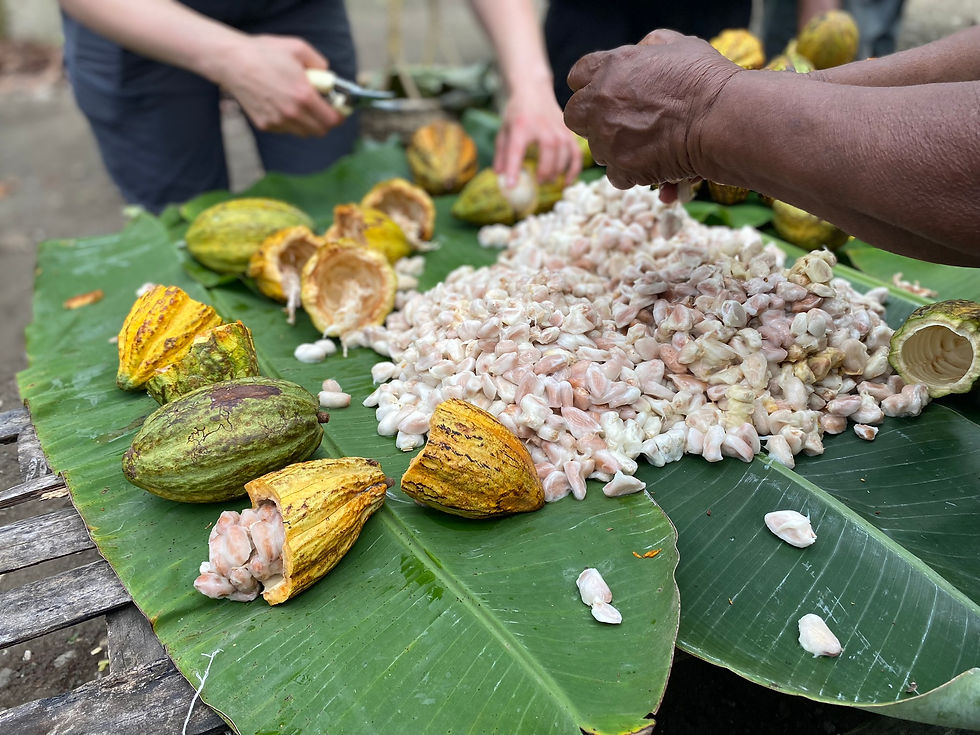
We tried our hand at splitting cacao pods — a small entry into the daily life of a farmer. Every time I visit a place of origin, I'm reminded again of how much time and effort lies behind the beans that reach us.
Where Cacao and Japanese Flavor Meet

During this visit, we prepared a 100% cacao chocolate drink made from Solomon Islands beans and offered it to the local producers.

In the Cacaogoto way, it was served alongside wagashi made with wasanbon and yuzu.

To bring chocolate made from the very cacao they had grown back to the hands of those producers — being present for that moment was something I won't forget.
The producers tasted the wasanbon quietly, taking their time. In the moment, there were no big reactions, and I found myself wondering how it had landed. But later, when we crossed paths again at an event, several people came to tell me: "The wasanbon was truly delicious." That delicate sweetness, dissolving softly in the mouth, had found its way to them — slowly, with time.
It was a quiet moment of meeting between different cultures, through cacao.
In Conversation with Producers

At another farm, we visited Agnes and her family, who grow cacao together.
In the Solomon Islands, many farms are run as family units — harvesting, fermenting, and drying all carried out together. Agnes was hardworking and warm, her love for her family present in everything she said.

During our visit, she sang for us. Listening to the soul in her voice, I was deeply moved — by the life she had given to cacao. There are things that no conversation about technique or quality can carry. Her way of living was there in that song.
A Local Chocolate Event

While in the Solomon Islands, we also attended a local chocolate event.
Local makers presented their products, and the gathering was a space for exchange aimed at developing the cacao industry in the region.

I participated as a judge in the chocolate competition.

Still growing, still finding its form — and yet, the diversity and quality of what was being made with Solomon Islands cacao left me with a strong sense of what is possible here.
The Character of Solomon Islands Cacao

Solomon Islands cacao carries a distinctive genetic diversity.
The Amelonado variety, prevalent in the region, is a strain derived from the Forastero family — yet shaped by the climate and soil particular to the Pacific, it has developed a flavor profile all its own. Fine chocolate makers around the world have taken notice.
At Cacaogoto, we continue to work with this cacao, drawing out what makes it singular.
Island Life and Culture

During the visit, we also attended a traditional festival on an island about three hours by boat from Honiara.
Families brought fish, taro, and other foods to share together across the village. No mobile signal reached this island. The life here — built around family and community — continues in a form largely unchanged.
Cacao is a crop rooted deep in that everyday life.
The quiet order of Grace's farm. Agnes's song. The shared table at the village festival. All of it is part of the landscape behind cacao as a material.
The Future Cacao Connects

What this journey made clear is that cacao, before it is an ingredient, is something that connects people.
The skill and pride of producers. The time of families. The culture of communities. All of it accumulates — and becomes chocolate. That is why Cacaogoto sees its role as carrying that background alongside the cacao itself, all the way to the people who receive it.


